Perihelion Promise
Let Perihelion Day serve as a metaphor for this sermon celebrating our place and time in the cosmos, especially as we approach the inauguration of our next U.S. president, Barak Obama.
It seems paradoxical that here on Perihelion Day, when we’re the closest to the sun, we’re so cold. If we’re three million miles closer now than we are on July 4th, Aphelion Day, why aren’t we hotter now and colder then? It depends more on the angle of the relationship than the distance. Our northern hemisphere gets a glancing-off short day of sunlight that also has to penetrate more atmosphere at that shallow angle. So, while we’re closer than ever, we’re coldest because of our angel of relationship with our sun, the source of all life and energy.
Most religions are interested in supernatural realities; I’m more interested in super natural realities. Most sermons elaborate on scriptural passages; I build on scientific and Deistic principles. Most preachers these days are more likely to talk about angels than angles. Let our angles evoke our angels. Let us make the perihelion paradox into the perihelion promise. This promise applies not just to solar energy and Obama’s presidency, but how we relate to our center, our source, as known in our sky, each other, and in ourselves.
It is because the Earth is tilted on its axis of rotation as it spins, traveling through the yearly seasons, that we’re so cold even when we’re closest. Short days, long nights, thicker atmosphere, a glancing path for rays – all these leave us cold in winter. But sit in a sunny window on a clear day, and you’ll be warmed. Merely face the sun with the proper attitude and relation, and its gifts flow into our lives. All energies of all forms are originally derived from our current sun or the former one we’re all made of. Our earth, our bodies, the uranium we use in nuclear power plants and bombs – all these came from the recondensed matter of a former sun that collapsed into itself and exploded out into cold space. The oil we suck up and burn in our engines was former plant life powered by our current sun long ago. The food we eat and the way it gets to us is all solar-derived. The sunny window that warms our back and room is using the ever-shining source directly. A house with windows and walls designed for space heating, and the rooftop for hot water and electricity production, merely relates to the sun in such a way as to stop warding off this incoming gift and instead welcome it with gratitude, ethics, and ingenuity.
How ethics? Because two houses sitting side by side can have vastly different consequences for the larger environment, especially when multiplied by the thousands and millions. This is more than mere economics or style. How we get our energy and what we do with it are ethical issues. One house wastes the sun’s energy with conventional roofing and ill-considered window placement. It wards off the daily sun in order to replace that heat and energy with depletable and problematic sources. Coal, oil, natural gas, nuclear, and even hydroelectric all exploit, deplete, or injure the single ecosystem we all share. It costs money to harm our planet to meet our needs.
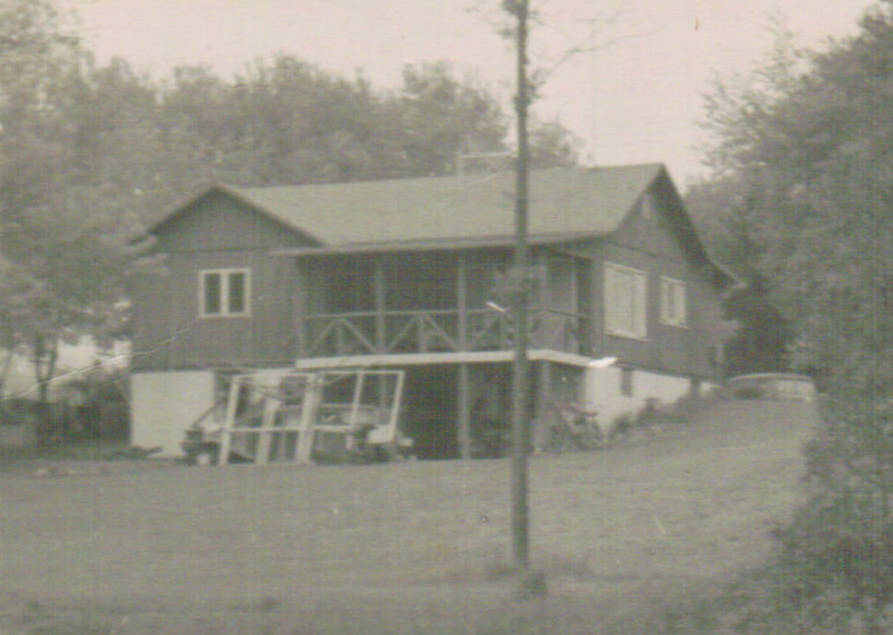
This first house is like mine. Let’s call it “Houses as They Used to Be” and let’s call the second house “Houses as They are Becoming.” I’ll use my boyhood house to illustrate both. The first is of the cottage on a lake in Michigan that we moved into. The second is the same house after my dad installed large windows on the formerly open porches. He fussed a lot about bringing a gas line to a heater to heat the larger space. What we discovered, however, was that the large south-facing windows helped heat the whole house. This was before solar heat was discussed for such house heating and hot water heating, and before the eventual solar cells that harvest sunlight to create free, clean, renewable electricity.